Threshold Training for the Half Marathon: Pace, Workouts, How Much
Half marathon pace sits just below threshold. How to find your threshold pace, which sessions work, how many fit in a week and what six plans do.
By Abner SantanaCoach and creator of Magic Training
25 min read
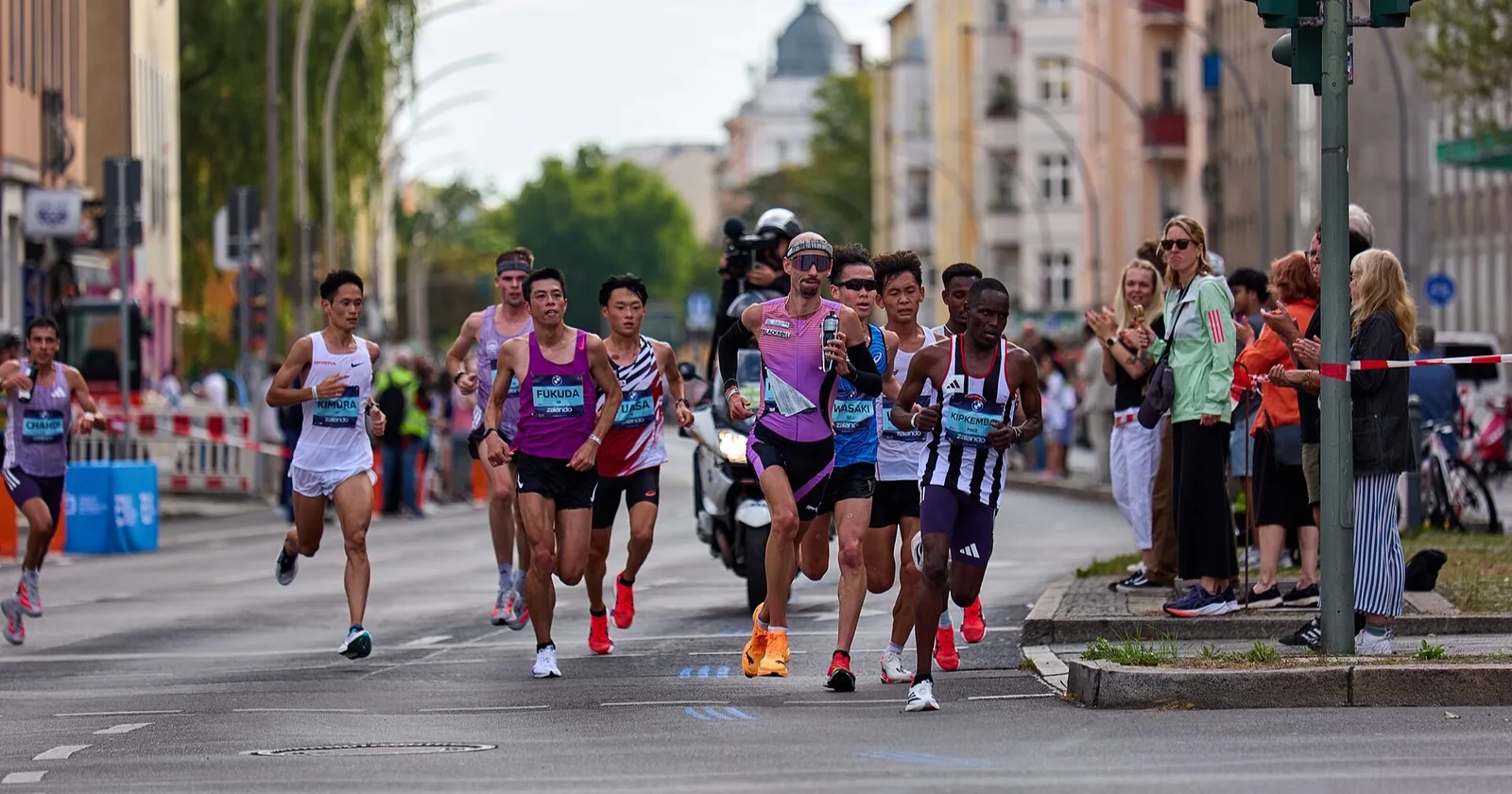
The half marathon is raced close to the lactate threshold, a little below it for almost every amateur, which makes threshold training the most race-specific quality session for the 21.1 km (13.1 mi). In eight runners finishing the half in about 1:35, race speed was 13.34 km/h (close to 4:30/km, or 7:14/mi). Speed at the maximal lactate steady state was 13.56 km/h (about 4:25/km, or 7:07/mi), a difference of under 2% (Legaz-Arrese et al., 2011). The two correlated at r = 0.83. The same runners held threshold speed for 64 ± 15 minutes to exhaustion, against a 95-minute race. That pair of numbers organizes the training: threshold is the intensity you can hold for about an hour, and your half lasts longer than that.
Threshold training works exactly the intensity the half demands, but the dose decides the outcome. Threshold-dominated weeks delivered less than pyramidal and polarized distributions in well-trained athletes and, with weaker statistical support, in amateurs. This guide shows how to find your threshold pace from a recent race and which session formats Daniels, Pfitzinger, Hansons and the Norwegian model use. Then it covers how many sessions fit in an amateur's week and how six half marathon plans in the catalog dose this work inside a complete half marathon training build.
Key takeaways
- Threshold pace (LT2, or maximal lactate steady state) is what trained runners sustain for 55 to 70 minutes in the studies. The half sits at or just below it; the longer your race, the bigger the gap.
- Take the pace from a recent race in the Magic pace calculator, never from the goal. Pfitzinger places threshold 8 to 15 s/km (about 13 to 24 s/mile) faster than goal half pace; Daniels calls T pace "comfortably hard", raceable for about 60 minutes.
- Sessions that work: 20 to 40 minutes continuous (elites go to 50) or intervals of 1 to 3 km, or 3 to 15 minutes, with 1 to 2 minutes of rest, adding up to 20 to 50 minutes of work.
- Dose: 1 session per week in the base phase, up to 2 in the specific phase, with the rest of the week truly easy; sub-threshold plans such as the Norwegian one use three shorter, more controlled sessions and require more mileage. The "threshold" group in Stöggl and Sperlich (2014), with 54% of training between thresholds, did not improve significantly.
- Heart rate at threshold varies widely (a mean of 90.6% of HRmax in 165 amateurs; 83 to 87% in the elite table), and Garmin's threshold pace estimate was 12% off in one study. The watch is a reference, not a judge.
What threshold is (and why the word confuses people)
In running, "threshold" almost always means the second threshold: the highest intensity at which lactate production and removal still balance. The review by Faude, Kindermann and Meyer (2009) located 25 different lactate threshold concepts in the literature, in three families. The first uses fixed lactate values (4 mmol/L is the classic example); the second, the first rise above baseline; the third gathers the methods that try to find the maximal lactate steady state (MLSS). The aerobic-anaerobic transition model has two points: the first threshold (LT1), where lactate starts to rise, and the second (LT2), which in theory coincides with the MLSS.
The 4 mmol/L figure is a population average, not your number. Lactate concentration at the MLSS varies from 2 to 8 mmol/L between individuals (Billat et al., 2003). In 165 recreational runners tested on a treadmill, LT2 appeared on average at 3.2 ± 0.6 mmol/L and LT1 at 1.7 ± 0.5 mmol/L (Nuuttila et al., 2025). Anyone chasing "4 mmol" may be above or below their own threshold.
Critical speed is the same boundary seen through the mathematics of fatigue: the highest intensity at which a physiological steady state still exists, sustainable for up to about one hour (Smyth and Muniz-Pumares, 2020). From here on, "threshold pace" means speed at LT2/MLSS: the pace you hold for about an hour in race conditions. T (Daniels), LT (Pfitzinger), tempo (Hansons) and sub-threshold (Norwegian model) all point to that band, with differences in dosing that come up below.
Where half marathon pace sits relative to threshold
The half is raced close to the second threshold, and a little below it for most amateurs. Three independent sources point to the same place. The elite-practice review by Haugen, Sandbakk, Seiler and Tønnessen (2022) uses "threshold" to mean "an intensity close to half-marathon pace" and places that pace at the upper end of the range between LT1 and LT2. Casado, Foster, Bakken and Tjelta (2023) write that speed at LT2 in continuous running is close to half marathon pace and that training in this zone is specific to races of 10 to 20 km (6.2 to 12.4 mi). Garmin's manual puts the experienced runner's threshold "between 10 km and half-marathon race pace" (Garmin, fenix 6 manual).
How long threshold lasts
In studies of trained runners, time to exhaustion at MLSS speed falls between 55 and 70 minutes. It was 64 ± 15 min in Legaz-Arrese (2011) and 68 ± 11 min in continuous running for the 10 runners of Dittrich et al. (2014). In the 13 athletes of Pallarés et al. (2026), it was 56 min 42 s (± 13 min), with 23% between-subject variation. Daniels describes T pace the same way: rested, you can race at it for about 60 minutes.
That leads to a practical inference. If threshold lasts about an hour and your half takes 1:45 or 2:00, your race pace has to sit below threshold, and the longer the race, the further below. A 1:05 runner races the half practically at threshold; a 2:00 runner has a larger margin. None of the studies above measured that gap by finishing time, so treat the rule as reasoning, not as a table. The marathon shows the extreme: across more than 25,000 recreational Strava runners, it was run at an average of 84.8% of critical speed (Smyth and Muniz-Pumares, 2020). The half sits much closer to threshold than that.
For training, the consequence is twofold. Threshold predicts the half: in 427 competitive runners, speed at the individual anaerobic threshold measured on a treadmill correlated at r = 0.88 to 0.93 with mean race speed over the long distances (Roecker et al., 1998). And the threshold session is the workout that most resembles the race you are going to run, without being the race. Correlation does not prove that training there improves your time. What the intervention studies show, further down, is the dose at which this work coexists with the rest of the week.
How to find your threshold pace
The most reliable path without a lab is a recent race. A 10K or a half from the last two or three months, raced properly, says more about your current fitness than any goal. Enter the result in the Magic pace calculator and use the threshold pace it returns as the starting point for your sessions. Do not start from the goal: a threshold derived from a wished-for time becomes a workout that is too hard, and the error repeats every week.
Magic pace calculator
Find your training paces
Enter a recent race and get the paces for every zone: easy, threshold, interval and race pace.
Calculate my pacesThe two most used coaching definitions arrive at the same place by different routes. Jack Daniels describes T pace as "comfortably hard": rested, you could race at it for about 60 minutes. Physiologically it sits around 86 to 88% of VO2max, or 88 to 90% of HRmax (Daniels, Daniels' Running Formula). Pete Pfitzinger, interviewed by Runner's World (Murphy, 2024), defines threshold pace as the effort you can sustain for about an hour. For the half, he places it "probably 8-15 seconds per kilometre faster than your goal half-marathon pace", roughly 13 to 24 seconds per mile.
The table applies Pfitzinger's rule to three common goals. Race pace is the finishing time divided by 21.0975 km; threshold pace is that value minus 8 to 15 s/km. It only works if the goal is realistic against your most recent race. If the goal is still far from current fitness, the calculator pace wins.
| Half marathon goal | Race pace | Threshold pace (8 to 15 s/km faster) |
|---|---|---|
| 2:00 | 5:41/km (9:09/mi) | 5:26 to 5:33/km (8:45 to 8:56/mi) |
| 1:45 | 4:59/km (8:01/mi) | 4:44 to 4:51/km (7:36 to 7:48/mi) |
| 1:30 | 4:16/km (6:52/mi) | 4:01 to 4:08/km (6:28 to 6:39/mi) |
Heart rate and perceived effort
Heart rate at threshold varies more between people than zone tables suggest. In the 165 recreational runners of Nuuttila et al. (2025), LT2 occurred on average at 90.6 ± 2.5% of HRmax, 87.0% of heart rate reserve and a perceived exertion of 15.4 ± 1.8 on the Borg 6-20 scale. LT1 sat at 80.7 ± 4.9% of HRmax. No fixed value put every participant in the same zone, and the mean errors of the fixed anchors ranged from 3.4 to 8.3%.
Practice references disagree with each other. The elite-practice table in Haugen (2022) places zone 3 (threshold) at 83 to 87% of HRmax and 2.0 to 3.5 mmol/L, with zone 4 at 88 to 92%. Daniels says 88 to 90%. Garmin says approximately 90% for experienced runners and, for average runners, "often well below 90% of maximum heart rate" (Garmin, fenix 6 manual).
| Marker | Value at threshold (LT2) | Source |
|---|---|---|
| % of HRmax, amateurs | 90.6 ± 2.5% (165 runners) | Nuuttila 2025 |
| % of HRmax, elites | 83 to 87% in zone 3; 88 to 92% in zone 4 | Haugen 2022 |
| % of HRmax, method | 88 to 90% | Daniels 2014 |
| % of HRmax, watch | about 90% for experienced runners; "well below" for average runners | Garmin manual |
| Perceived exertion (Borg 6-20) | 15.4 ± 1.8 | Nuuttila 2025 |
| Perceived exertion (Borg 6-20) | 13.6 ± 1.8 at the individual anaerobic threshold; 14.1 ± 2.0 at 4 mmol/L (2,560 adults) | Scherr 2013 |
| Lactate | 3.2 ± 0.6 mmol/L on average; 2 to 8 mmol/L between individuals | Nuuttila 2025; Billat 2003 |
| Talk | short phrases come out; conversation does not | practical cue, no study |
To turn a percentage into beats per minute you need a reliable HRmax, measured or estimated with care (heart rate calculator), and a sense of where the threshold zone sits relative to the others (running training zones). In 2,560 adults, the individual anaerobic threshold corresponded to a perceived exertion of 13.6 ± 1.8 on the Borg scale, and 4 mmol/L to 14.1 ± 2.0. The authors recommend 13 to 15 for "more intense but still aerobic" training (Scherr et al., 2013). In Daniels' words: comfortably hard. You can speak in short phrases, not hold a conversation.
Garmin's lactate threshold estimate
Garmin estimates lactate threshold from its VO2max estimate, heart rate and pace. Automatic detection happens during runs at a steady, high intensity and requires a Garmin chest heart rate monitor; there is also a guided test, which needs GPS (Garmin, fenix 6 manual; guided test). The watch needs a few runs with the strap to get HRmax right, and if no estimate appears the manual suggests manually lowering your HRmax value.
Independent evidence on accuracy is thin. A 2025 systematic review gathered what exists (Železnik Mežan, 2025). On the Fenix 6, speed at threshold had a mean absolute percentage error of 7.52% (CCC 0.79), but heart rate at threshold was not considered valid (CCC below 0.70). In another study, on the Fenix 7, the watch's threshold pace was 11.96% below the value measured in a lactate field test; the authors judged it sufficient for recreational athletes, not for professionals. The review notes that only one study has demonstrated the validity of this estimate in a smartwatch. For a runner with a threshold near 4:50/km (7:47/mi), 12% is about 35 s/km (56 s/mile), enough to change zone. Use the watch's number as a starting point and correct it against your recent race.
The threshold sessions that work for the half
The well-known methods converge on the same core: a pace around half marathon pace or slightly faster, 20 to 50 minutes of work per session, and short rests when there are rests at all. What changes is the name and how the work is divided.
| Format (method) | Work | Rest | Total work | Source |
|---|---|---|---|---|
| Tempo run (Daniels) | about 20 min continuous at T pace | none | about 20 min | Daniels 2014 |
| Cruise intervals (Daniels) | 5 × 1 mile (1.6 km) or 3 × 2 miles (3.2 km) at T pace | 1 min or 2 min (work:rest about 5:1) | 8 to 10 km (5 to 6 mi) | Daniels 2014 |
| Continuous threshold run (elite) | 20 to 50 min (7 to 15 km, 4.3 to 9.3 mi) near half marathon pace | none | 20 to 50 min | Haugen 2022 |
| Threshold intervals (elite) | 10 to 12 × 1000 m; 6 to 8 × 1500 to 2000 m; 4 × 5000 m, "around half-marathon pace or slightly faster" | 1 min; 1 to 2 min; 1000 m jog | 30 to 75 min (elite) | Haugen 2022 |
| LT run (Pfitzinger) | 3 × 3 km (1.9 mi) at threshold pace | 2 min jog | 9 km (5.6 mi) | Murphy, Runner's World 2024 |
| Tempo at goal half pace (Hansons) | 3 miles (4.8 km) in week 2, rising to 7 miles (11.3 km) in weeks 14 to 16, with 1.5 miles of warm-up and cool-down | none | 4.8 to 11.3 km | Hansons, Advanced Half Marathon (PDF) |
| Sub-threshold (Norwegian model, catalog plan) | 5 × 6 min; 10 × 3 min; 5 × 1 km at controlled threshold | 1 min | 25 to 30 min | catalog plan |
In Hansons, the threshold-zone session is the "tempo" at goal half marathon pace, not a faster pace. By the logic of the previous section, the goal pace of anyone finishing the half in more than an hour sits just below threshold. The workout lands at the lower edge of the zone, and that is what allows 11 km (7 miles) continuous without it turning into a race. The official advanced plan rises from 3 miles in week 2 to 7 miles in week 14, with 5 miles in week 17 and the race in week 18 (Hansons Coaching Services, Advanced Half Marathon).
When to use continuous runs and when to use intervals
Both work and they serve different ends. The continuous run teaches you to sustain the pace and is the closest thing to the race: Daniels sets the tempo run at about 20 minutes, and Haugen et al. (2022) describe 20 to 50 minutes in elites. Intervals with 1 to 2 minutes of rest let you accumulate more minutes at the intensity (30 to 75 minutes in elites) and run "around half-marathon pace or slightly faster". The Norwegian model combines the short rest with lactate measurements every one to three repetitions, to keep concentration between 2 and 4.5 mmol/L, with rests of 20 seconds to 1.5 minutes (Casado et al., 2023). Without a lactate meter, your controls are the calculator pace, heart rate as an alarm, and the feeling that you could finish two more repetitions. For the half, alternate: continuous one week, intervals the next, and race-pace blocks in the specific phase.
How much threshold per week
One threshold session per week in the base phase and up to two in the specific phase, with everything else easy, is the budget consistent with the evidence for an amateur. In the intervention studies, distributions with more time between the thresholds improved less than more polarized ones, and in one of them the improvement was not even significant.
What the intervention studies show
In the trial by Stöggl and Sperlich (2014), 48 well-trained endurance athletes (21 of them runners) trained for 9 weeks under four distributions. The polarized group improved VO2peak by 11.7%, time to exhaustion by 17.4% and speed at 4 mmol/L by 8.1%. The "threshold" group, with 54% of training between thresholds and nothing at high intensity, did not significantly improve any of those variables. The sample mixed sports and the study lasted 9 weeks, but the direction repeats in runners.
In 30 recreational runners followed for 10 weeks, the polarized distribution (77% easy, 3% between thresholds, 20% hard) improved 10K time by 5.0%, against 3.6% for the "between thresholds" distribution (46/35/19). The difference was not significant in the whole group, but it was in the subgroup that followed the plan most closely (Muñoz et al., 2014).
In 12 sub-elite runners trained for 5 months, the group with more zone 1 (80.5/11.8/8.3) cut 157 ± 13 seconds from a 10.4 km (6.5 mi) race. The group with more zone 2 (66.8/24.7/8.5) cut 121.5 ± 7.1 seconds, p = 0.03 (Esteve-Lanao et al., 2007). In 60 well-trained runners, all four distributions tested over 16 weeks improved 5K time. The pyramidal distribution (about 16% in zone 2) that turned polarized in the final weeks improved most: 1.5%, against 0.6 to 1.1% for the others (Filipas et al., 2022).
The systematic review by Kenneally, Casado and Santos-Concejero (2018), covering 16 studies, sums it up: pyramidal and polarized training are more effective than threshold-dominated training. That does not mean zero threshold. Elite runners use tempo runs or intervals at vLT2 at least once a week, inside a pyramidal distribution that turns polarized close to competition (Casado et al., 2022). Threshold-zone work represents 5 to 15% of their total volume, with 80% or more at low intensity (Haugen et al., 2022). Among 85 elite runners, with data from 3, 5 and 7 years of systematic training, easy-run volume and tempo runs were the activities that explained the variance in performance (Casado et al., 2021). Threshold and easy running are partners, not rivals.
Why the rest of the week has to be easy
What makes the budget work is the easy part being truly easy. In 9 highly trained runners, heart rate variability returned to baseline 5 to 10 minutes after 60 or 120 minutes below the first ventilatory threshold. After 30 minutes between the thresholds it took about 30 minutes, practically the same as after 6 × 3 min above the second threshold. In trained but non-elite runners, recovery took more than 90 minutes (Seiler, Haugen and Kuffel, 2007). A threshold session is not "half a hard workout": on this marker it costs recovery like an interval session, and it costs more for those who train less. Easy runs that drift into moderate pay that cost without the stimulus. The full logic of the distribution is in polarized 80/20 training.
In numbers for an amateur's week: 1 threshold session in the base phase, with 20 to 30 minutes of work; up to 2 in the specific phase, on non-consecutive days; long run and easy runs at an easy pace. This is coaching guidance consistent with those studies, not a value measured in them.
How six half marathon plans in the catalog dose threshold
The table below comes from reading, workout by workout, the threshold zone in six half marathon plans from the Magic Training catalog (data from 20 Oct 2026). It shows how many sessions per week contain blocks in that zone, the typical format and each plan's largest session.
| Plan | Length | Threshold sessions per week | Typical format | Largest threshold session |
|---|---|---|---|---|
| Pfitzinger intermediate | 12 wk | 1 in the first 7 weeks, plus 3 to 5 km (1.9 to 3.1 mi) at threshold at the end of the long run in weeks 3, 5 and 7; none from week 8 on | two blocks with 4 min jog (14+12, 18+12, 18+15 and 20+16 min), then continuous | 38 min continuous (week 7) |
| Daniels intermediate | 24 wk | starts in week 8; 1 per week, 2 in weeks 14, 17, 18 and 19 | cruise intervals (5×5 min with 1 min; 4×12 min with 90 s; 8×5 to 6 min with 30 s; 4×1200 m) and threshold blocks separated by easy running (e.g. 2×10 min + 50 min easy + 15 min threshold) | 4×12 min with 90 s (weeks 12 and 13) |
| Hansons advanced | 18 wk | 1 (Thursday) from week 2 to 17 | continuous at goal half marathon pace, with 2 km (1.2 mi) warm-up and 2 km cool-down | 11 km (6.8 mi) continuous (weeks 14, 15 and 16); 8 km (5 mi) in the last |
| 80/20 level 2, Matt Fitzgerald | 15 wk | 1, plus 10 to 15 min at threshold at the end of the long run in weeks 9, 11 and 13 | 10 to 40 min continuous or 3 to 4×5 min with 1 min | 40 min continuous (week 13) |
| Half Marathon Sub 1:45 (catalog plan) | 12 wk | 1 | 10 to 30 min continuous | 30 min continuous (weeks 6, 8 and 10) |
| Norwegian Method advanced (catalog plan) | 14 wk | 2 to 3 (3 in the loading weeks, weeks 1 to 9) | sub-threshold intervals with short rest: 5 to 8×6 min, 9 to 14×3 min and 5 to 6×1 km with 1 min; 3 to 4×2 km (1.2 mi) with 2 min; 3×3 km (1.9 mi) with 3 min | 8×6 min with 1 min (weeks 7 and 9): 48 min at controlled threshold |
In the Pfitzinger plan, from week 8 on threshold gives way to VO2max intervals (1200, 1000 and 800 m) and 10K tune-up races in weeks 8 and 10. The Seiler polarized intermediate plan, from the same catalog, has no session marked in the threshold zone: its intensity sits in intervals above threshold and in marathon-pace blocks.
Two patterns stand out. Five of the six plans work with one threshold session per week in the weeks where it appears; a second one shows up only in specific weeks (Daniels) or as a piece of the long run (Pfitzinger and 80/20). The Norwegian plan is the deliberate exception, with two or three controlled sub-threshold sessions per week and everything else easy, and it asks for a base of 55 km (34 mi) per week or more. The second pattern is the naming: Hansons calls the run at goal half pace a "tempo", Pfitzinger calls it "LT" and Daniels calls it "T". In the catalog, all of them sit in the plan's threshold zone. The three methods applied to the marathon are compared in Daniels vs Pfitzinger vs Hansons.
Example progression over 10 to 12 weeks
The table is an example of how to distribute the formats above across 12 weeks for someone already running four or five times a week. It is not a complete plan: the long run, easy runs and any speed work are left out, and the weekly structure is in half marathon training. Paces come from the calculator and should be updated if you race a 10K mid-cycle. With 10 weeks, shorten the base to two.
| Phase | Weeks | Threshold sessions | Format | Work in the zone |
|---|---|---|---|---|
| Base | 1 to 4 | 1 per week | 3 × 8 min with 1.5 min jog, rising to 3 × 10 min with 2 min | 24 to 30 min |
| Build | 5 to 8 | 1 per week (2 in week 7, if recovery allows) | 20 min continuous, then 25 to 30 min; or 4 × 10 min with 90 s; or 5 × 1 mile with 1 min | 20 to 40 min |
| Specific | 9 to 11 | 1 threshold + 1 half-pace block | threshold: 3 × 3 km (1.9 mi) with 2 min, 3 to 4 × 2 km (1.2 mi) with 2 min, or 5 × 1 km with 1 min; half pace: 6 to 10 km (3.7 to 6.2 mi) continuous or at the end of the long run | 20 to 45 min of threshold, depending on format and pace, plus 6 to 10 km at race pace |
| Race week | 12 | 1 short | 3 × 2 km (1.2 mi) at threshold on Tuesday or Wednesday; 2 to 3 km (1.2 to 1.9 mi) at race pace on Thursday | 6 km (3.7 mi) of threshold (about 25 to 33 min, depending on pace) |
The half-pace block is the week's second quality session, not a third. Pick the format by level: a 2:00 runner stays with 5 × 1 km or 3 × 2 km; a 1:30 runner gets to 3 × 3 km. The half marathon taper is short, 7 to 14 days is usually enough, with one short threshold session and one race-pace block in the final week; the half marathon section of the marathon taper guide explains the logic.
Common mistakes
Running threshold too hard
The most frequent mistake and the most expensive. Threshold is "comfortably hard" (Daniels); if the session ends like a 10K race, the pace was above threshold and the workout changed zone. The Norwegian model exists to prevent exactly this: lactate measured every few repetitions, with a ceiling of 4.5 mmol/L (Casado et al., 2023). Practical check: in the last 5 minutes you still hold the pace without forcing your breathing, and you could do one more repetition if you had to.
Too much threshold in the week
Two or three sessions between the thresholds, plus "pushed" easy runs, reproduce the distributions that delivered less in the intervention studies above. Norwegian elites run 3 to 4 sub-threshold sessions per week inside 150 to 180 km (93 to 112 mi) per week (Casado et al., 2023). Without that volume, two threshold sessions are a sensible ceiling. The exception is plans built on short, controlled sub-threshold sessions, such as the Norwegian plan in the catalog, which trade intensity for frequency and require 55 km (34 mi) a week or more.
Trusting heart rate or the watch's threshold blindly
Heart rate at threshold ranges from 83 to 91% of HRmax across the sources above and suffers in heat and fatigue. Garmin's estimate was 11.96% off in one Fenix 7 study, and heart rate at threshold was not validated on the Fenix 6 (Železnik Mežan, 2025). Use heart rate and the watch as an alarm, not as a target. The target is the pace taken from a recent race.
Easy runs that turn moderate
As the autonomic recovery study by Seiler et al. (2007), covered in the weekly-dose section, showed, crossing the first threshold multiplies recovery time. The moderate run charges that recovery without delivering the specific stimulus, and the next threshold session comes out worse.
Pace taken from the goal, not from a recent race
A threshold calculated from a wished-for time pushes the whole training block upward: every repetition becomes a bit of a race, and the week does not close. Use the Magic pace calculator with your most recent race and revise after every 10K or half. The goal is tested on race day, not on a Tuesday.
FAQ
Is threshold pace the same as half marathon pace?
Almost, and the gap grows with your finishing time. In 8 runners finishing in 1:35, half marathon speed was within 2% of MLSS speed (Legaz-Arrese et al., 2011). Since threshold lasts about an hour, a 1:45 or 2:00 runner races with a larger margin, although no study has measured that margin by finishing time. Pfitzinger places threshold 8 to 15 s/km faster than goal half pace (Murphy, 2024), and Garmin puts the experienced runner's threshold between 10K pace and half marathon pace.
How many threshold sessions per week for the half?
One in the base phase, up to two in the specific phase. Elite runners use tempo runs or intervals at vLT2 at least once a week (Casado et al., 2022); the Norwegian model reaches 3 or 4 sessions, but inside 150 to 180 km per week and with lactate measured (Casado et al., 2023). In the catalog, five of the six half marathon plans analyzed use one threshold session per week; the Norwegian one uses two or three and asks for a base of 55 km (34 mi) or more.
Continuous or interval threshold training?
Both, alternated. The continuous run (20 to 40 minutes) is the closest thing to the race; intervals with 1 to 2 minutes of rest allow more minutes at the intensity and a pace "slightly faster" than half marathon pace, according to the elite practice described by Haugen et al. (2022). Daniels uses both formats: a tempo run of about 20 minutes and cruise intervals such as 5 × 1 mile with 1 minute.
Can you trust Garmin's lactate threshold?
As a starting point, yes; as a training target, no. Detection requires a chest strap and builds on the watch's VO2max estimate. In the review by Železnik Mežan (2025), speed at threshold on the Fenix 6 had a mean error of 7.52% and heart rate at threshold was not valid. On the Fenix 7, threshold pace was 11.96% below the lactate field test. Correct it against your recent race in the Magic pace calculator.
Does running threshold a little harder speed up progress?
There is no evidence that it helps. In a 9-week trial, a high dose of intermediate intensity brought no significant improvement: the "threshold" group in Stöggl and Sperlich (2014) did not improve significantly on any of the performance variables measured. The Norwegian model keeps lactate controlled precisely so that, according to its authors, runners recover faster and absorb more volume (Casado et al., 2023). Harder than threshold is a different workout, VO2max work, which has its place in the week but does not replace this one.
References
- Legaz-Arrese A, Carranza-García LE, Serrano-Ostáriz E, González-Ravé JM, Terrados N. The traditional maximal lactate steady state test versus the 5×2000 m test. International Journal of Sports Medicine, 2011;32(11):845-50. PubMed 22012640
- Faude O, Kindermann W, Meyer T. Lactate threshold concepts: how valid are they? Sports Medicine, 2009;39(6):469-90. PubMed 19453206
- Billat VL, Sirvent P, Py G, Koralsztein JP, Mercier J. The concept of maximal lactate steady state: a bridge between biochemistry, physiology and sport science. Sports Medicine, 2003;33(6):407-26. PubMed 12744715
- Nuuttila OP, Kaikkonen P, Sievänen H, Vasankari T, Kyröläinen H. The accuracy of fixed intensity anchors to estimate lactate thresholds in recreational runners. European Journal of Applied Physiology, 2025;125(8):2161-71. PMC12354492
- Smyth B, Muniz-Pumares D. Calculation of critical speed from raw training data in recreational marathon runners. Medicine & Science in Sports & Exercise, 2020;52(12):2637-45. PMC7664951
- Haugen T, Sandbakk Ø, Seiler S, Tønnessen E. The training characteristics of world-class distance runners: an integration of scientific literature and results-proven practice. Sports Medicine - Open, 2022;8(1):46. PMC8975965
- Casado A, Foster C, Bakken M, Tjelta LI. Does lactate-guided threshold interval training within a high-volume low-intensity approach represent the "next step" in the evolution of distance running training? International Journal of Environmental Research and Public Health, 2023;20(5):3782. PMC10000870
- Dittrich N, de Lucas RD, Beneke R, Guglielmo LG. Time to exhaustion at continuous and intermittent maximal lactate steady state during running exercise. International Journal of Sports Physiology and Performance, 2014;9(5):772-6. PubMed 24235775
- Pallarés JG, Valenzuela PL, Martínez-Cava A, et al. Time to exhaustion at traditional physiological indicators in runners: between-subject and between-day variability. International Journal of Sports Physiology and Performance, 2026. PubMed 41722553
- Roecker K, Schotte O, Niess AM, Horstmann T, Dickhuth HH. Predicting competition performance in long-distance running by means of a treadmill test. Medicine & Science in Sports & Exercise, 1998;30(10):1552-7. PubMed 9789858
- Daniels J. Daniels' Running Formula. Champaign: Human Kinetics, 3rd ed. 2014 (4th ed. 2021). Chapter on training intensities. Publisher page
- Murphy S. How experienced half marathoners can boost their training (interview with Pete Pfitzinger). Runner's World Australia, 17 Jul 2024. runnersworldonline.com.au
- Hansons Coaching Services. Advanced Half Marathon training plan (PDF, version 3.15). Hansons Coaching Services, PDF
- Stöggl T, Sperlich B. Polarized training has greater impact on key endurance variables than threshold, high intensity, or high volume training. Frontiers in Physiology, 2014;5:33. Frontiers
- Muñoz I, Seiler S, Bautista J, España J, Larumbe E, Esteve-Lanao J. Does polarized training improve performance in recreational runners? International Journal of Sports Physiology and Performance, 2014;9(2):265-72. PubMed 23752040
- Esteve-Lanao J, Foster C, Seiler S, Lucia A. Impact of training intensity distribution on performance in endurance athletes. Journal of Strength and Conditioning Research, 2007;21(3):943-9. PubMed 17685689
- Filipas L, Bonato M, Gallo G, Codella R. Effects of 16 weeks of pyramidal and polarized training intensity distributions in well-trained endurance runners. Scandinavian Journal of Medicine & Science in Sports, 2022;32(3):498-511. PMC9299127
- Kenneally M, Casado A, Santos-Concejero J. The effect of periodization and training intensity distribution on middle- and long-distance running performance: a systematic review. International Journal of Sports Physiology and Performance, 2018;13(9):1114-21. PubMed 29182410
- Casado A, González-Mohíno F, González-Ravé JM, Foster C. Training periodization, methods, intensity distribution, and volume in highly trained and elite distance runners: a systematic review. International Journal of Sports Physiology and Performance, 2022;17(6):820-33. PubMed 35418513
- Casado A, Hanley B, Santos-Concejero J, Ruiz-Pérez LM. World-class long-distance running performances are best predicted by volume of easy runs and deliberate practice of short-interval and tempo runs. Journal of Strength and Conditioning Research, 2021;35(9):2525-31. PubMed 31045681
- Seiler S, Haugen O, Kuffel E. Autonomic recovery after exercise in trained athletes: intensity and duration effects. Medicine & Science in Sports & Exercise, 2007;39(8):1366-73. PubMed 17762370
- Scherr J, Wolfarth B, Christle JW, Pressler A, Wagenpfeil S, Halle M. Associations between Borg's rating of perceived exertion and physiological measures of exercise intensity. European Journal of Applied Physiology, 2013;113(1):147-55. PubMed 22615009
- Železnik Mežan L. Accuracy of wearables for determining the maximal oxygen uptake and lactate threshold: a qualitative systematic review. Frontiers in Sports and Active Living, 2025. PMC12748164
- Garmin. Lactate threshold, and Performing a guided test to determine your lactate threshold. fenix 6 Owner's Manual. Lactate threshold; guided test
- Catalog data read on 20 Oct 2026 from the workouts of each half marathon plan in the catalog, counting the sessions with blocks marked in the plan's threshold zone, their format and the largest session.
Plans mentioned in this article
Daniels Half Marathon – Intermediate
Jack Daniels24 weeks
Pfitzinger Half Marathon – Intermediate
Pete Pfitzinger12 weeks
Hansons Half Marathon Method Advanced
Hansons18 weeks
80/20 Half Marathon – Level 2
Matt Fitzgerald15 weeks
Half Marathon Norwegian Method
Magic Training14 weeks
Find your plan
Which plan fits your next race?
Answer a few questions about distance, goal and routine and see the plans that fit where you are right now.
Find my plan