
Strength training for runners: 2 to 3 sessions a week
What the reviews show about strength and running, how many sessions a week, what load and which exercises to use, and how to adjust from base to taper.
By Abner SantanaCoach and creator of Magic Training
18 min read
In this article
Yes, strength work improves running. Two to three sessions a week, with heavy loads and few repetitions, tend to improve running economy and race time up to 10 km (6.2 mi), without changing VO2max. A systematic review of 24 studies in runners reports gains of 2 to 8% in economy and 2 to 4% in time trials up to 10 km (Blagrove et al., 2018). The effects showed up in programs of 6 to 14 weeks, with larger gains in the longer ones. Not every study finds a gain and several have small groups, so treat the numbers as the average of an imperfect literature.
One limit on scope: the races in these studies run from 1,500 m to 10 km, and part of the evidence comes from cycling, skiing and swimming. For the half marathon and the marathon there is no direct race-time data.
Below you will find the evidence, how to choose the load, exercises by movement pattern, a week with four running days, and how to adjust strength work from the base block to the taper.
Key takeaways
- Two sessions a week are the starting point; the reviews recommend two to three, for 10 to 12 weeks or more.
- Strength improves running economy (2 to 8% in a review of 24 studies) and race time up to 10 km (2 to 4%), but usually leaves VO2max and body composition as they were.
- Heavy load beats light load: in the Llanos-Lagos (2024) economy meta-analysis, 80% of one-repetition maximum or more improved economy, and 40 to 79% did not.
- Cover six patterns, with one or two exercises each: squat, hip hinge, single leg, calf, push and pull, and trunk.
- In the specific phase, keep the load and cut the sets; in the taper, reduce volume and add nothing new.
- If you have pain or an active injury, see a doctor or physical therapist first.
What strength training changes in running
Strength work improves running economy and race time at middle and long distances, does not change VO2max and, across sports in general, reduces injuries. Economy is the energy cost of holding a speed below your maximum. The numbers come from reviews with different methods and do not add up. In the tables, g and the values in parentheses are effect sizes: the further from zero, the larger the effect, and an interval that crosses zero signals uncertainty. In Balsalobre-Fernández, Llanos-Lagos and Eihara, a negative sign favors strength training; in Berryman, a positive one does.
| Outcome | What the evidence shows | Source |
|---|---|---|
| Running economy | 2 to 8% improvement versus control groups, "although not always" (20 of the 24 studies measured economy) | Blagrove et al., 2018 |
| Running economy | Large effect (-1.42; 95% interval: -2.23 to -0.60) in 5 studies with 93 runners with VO2max above 60 ml/kg/min | Balsalobre-Fernández et al., 2016 |
| Race time | 3 to 5% improvement over 1,500 to 3,000 m and 2 to 4% up to 10 km; 8 of 12 time trials improved significantly | Blagrove et al., 2018 |
| Race time | Moderate improvement (0.52; interval 0.33 to 0.70) in 28 studies of running, cycling, skiing and swimming; maximal strength ahead of the other intensities | Berryman et al., 2018 |
| Running when fatigued | At 90 minutes of running, oxygen cost fell 2.1% in the strength group and rose 0.6% in the running-only group; time to exhaustion rose 35% versus a drop of 8%. One trial, 28 men | Zanini et al., 2025 |
| VO2max, lactate, body composition | No change in most studies; no method improved VO2max or velocity at VO2max in the second Llanos-Lagos meta-analysis | Blagrove et al., 2018; Llanos-Lagos et al., 2024b |
Rønnestad and Mujika conclude that economy improves with heavy or explosive strength work added to running. As mechanisms, they propose later recruitment of less efficient type II fibers, better neuromuscular efficiency and greater muscle-tendon stiffness; these are hypotheses, not measured facts (Rønnestad and Mujika, 2014). The concept of economy is covered in the video Running Economy: concept and why it matters (video in Portuguese), from the channel of Abner Santana.
The reviews disagree on one point: Blagrove et al. report improved 20 to 30 m sprint times, and Llanos-Lagos found no effect on sprint capacity.
Injuries. In a meta-analysis of 25 studies with 26,610 participants, strength training had a relative injury risk of 0.315 (0.207 to 0.480), less than a third of the control group. Exercise programs in general reduced overuse injuries (0.527), and stretching had no effect (0.963) (Lauersen et al., 2014). The 2018 update pooled six studies and 7,738 participants and found a relative risk of 0.338. Each additional 10% of strength volume reduced the risk by more than four percentage points (Lauersen et al., 2018). These are data from sports in general, not only running. See also running injuries and stretching for runners.
Heavy load or light load?
Heavy load, from 80% of one-repetition maximum (1RM) up or sets that end within 7 repetitions, has the most consistent evidence for runners. In the economy meta-analysis by Llanos-Lagos et al. (2024) (31 studies, 652 runners), this method improved economy, while training at 40 to 79% of 1RM and isometric training did not. Plyometrics only helped at speeds up to 12 km/h.
| Method | Running economy | Race time |
|---|---|---|
| Heavy load (80% of 1RM or more) | Small (-0.27) | Moderate (-0.47) |
| Combined methods | Moderate (-0.43; low certainty) | Large (-1.04) |
| Plyometrics (jumps) | No overall effect; small up to 12 km/h (-0.31) | No significant effect (-0.21) |
| Moderate load (40 to 79% of 1RM) | No effect | Not reported |
| Isometric | No effect | Not reported |
Table source: Llanos-Lagos et al., 2024 for economy and Llanos-Lagos et al., 2024b for race time. Negative values favor the group that did strength work; "Not reported" means the review summary does not report the method for that outcome.
In a direct comparison of 22 studies, heavy load beat plyometrics on economy (g = -0.32 versus -0.13). Loads near the maximum, 90% of 1RM or more, had g = -0.31 versus -0.17 below that, with an interval that crosses zero. Programs of 10 to 14 weeks were better than those of 6 to 8 (g = -0.45 versus -0.21) (Eihara et al., 2022).
The classic example of heavy load is an eight-week trial with 17 well-trained runners, 8 of them in the strength group. The training was half squats, four sets of four repetitions, three times a week. It improved economy by 5.0% and strength by 33.2%, with no change in VO2max or body weight (Støren et al., 2008).
There is a caveat. Four of the five studies in the Balsalobre-Fernández et al. meta-analysis used 40 to 70% of 1RM, with up to 200 jumps and 5 to 10 short sprints, and the effect was large. Light load with jumps may work, but heavy load has more support. As a practical translation, use 3 to 4 sets of 3 to 6 repetitions on the main exercises, with a load that leaves one or two repetitions in reserve, and raise the weight every one or two weeks. This is a practical training rule, not a study result.
Plyometrics stays out of the exercise table because, on its own, it produced less than heavy load in the direct comparison (g = -0.13 versus -0.32). In the two Llanos-Lagos meta-analyses (economy, above, and performance), combined methods (more than one type of strength training in the same intervention) produced more than a single method, but the certainty of that estimate is low. That is why heavy load is the default here. As a practical rule, not a study finding: if you want to add jumps, wait until you have a 10 to 12 week strength base and start with one short, light session a week, on an easy day, away from the long run.
How many times a week and how much volume
Two sessions a week are the starting point for someone who runs four days. Blagrove et al. conclude that two to three supervised sessions give enough stimulus in 6 to 14 weeks and that the gain tends to be larger in longer programs. Balsalobre-Fernández et al. reach the same range, 2 to 3 times for 8 to 12 weeks. In the second Llanos-Lagos meta-analysis, the number of sessions per week did not explain differences in performance between studies (p > 0.166): the data do not show that more sessions give more.
The volume in the studies is modest. In the heavy-load protocols described by Blagrove et al., the typical prescription is 2 to 6 sets of 3 to 10 repetitions per exercise, at more than 70% of 1RM or to failure. In Balsalobre-Fernández et al., it is 2 to 4 lower-body exercises. As an estimate from this article, not study data, a 30 to 45 minute session with 4 to 6 exercises fits that range. In some protocols there were 48 to 72 hours between strength sessions, done separately from running. Three sessions compete with running for recovery; keep them for when your running volume is still low. How to write these sessions as text and send them to your watch is covered in strength workouts.
Exercises by movement pattern
Pick one or two exercises per pattern instead of a list of machines. Blagrove et al. favor multi-joint, closed-chain exercises such as the squat, lunge and leg press, because they resemble the running movement more. Studies that used only machines or a single-joint exercise showed no effect on economy. The protocols are centered on the legs; pushing, pulling and trunk work are included for general balance, not because they have been shown to improve economy.
| Pattern | Exercises (1 to 2) | Starting scheme | Note |
|---|---|---|---|
| Squat | Barbell or goblet squat; leg press | 3-4 × 3-6 | Main lift of session A; Støren used a half squat 4 × 4 |
| Hip hinge | Romanian deadlift; trap-bar deadlift | 3 × 4-6 | Lower with control; technique before load |
| Single leg | Bulgarian split squat; lunge or step-up | 3 × 6-8 per leg | Session B, supporting: no direct economy test; moderate load, not to failure |
| Calf | Standing raise; seated raise | 3 × 6-10, slow lowering | The seated raise works the soleus more |
| Push and pull (two patterns, counted as one group) | Bench press or push-up; row | 2-3 × 6-10 | One of each, for general coverage |
| Trunk | Side plank; Pallof press or dead bug | 2-3 × 30-40 s | At the end of the session |
The scheme is a starting point, not a single protocol. Session A concentrates the squat, hip hinge and calf with heavy load; session B groups single leg, push and pull and trunk with moderate load. B is a supporting session: the economy studies did not test these exercises, so the expected economy gain comes from A, and B serves balance and a second, lighter stimulus. More options are in exercises for runners. On video, the channel of Abner Santana has Strength training for runners: how lifting improves running (video in Portuguese).
An example week with four running days
The rule is to concentrate the stress: heavy strength work on the quality day, after the run, and a second session on an easy day, away from the long run. This keeps easy days easy and lets you reach the long run with fresh legs. It is a design, not a prescribed workout.
| Day | Running | Strength |
|---|---|---|
| Monday | Rest | None |
| Tuesday | Quality (intervals or threshold), in the morning | Session A (heavy), in the afternoon or evening |
| Wednesday | Rest | None |
| Thursday | Easy run | Session B (moderate), after the run |
| Friday | Rest | None |
| Saturday | Short easy run | None |
| Sunday | Long run | None |
Three rules support the design. First: run the quality session before lifting and leave at least three hours between the two. In a meta-analysis of 43 studies, the gain in explosive strength was attenuated when aerobic and strength work were done in the same session. With 3 hours or more between them, the attenuation was no longer significant, and maximal strength and hypertrophy were not affected. The sample was healthy adults, not runners (Schumann et al., 2022).
Second, as a practical rule with no study in runners to fix it: avoid a heavy leg session in the 48 hours before a quality session or the long run, especially in the first weeks, when muscle soreness is greatest (see the muscle soreness section below). Third: if the week has two quality sessions, put heavy strength on the day of the first and moderate strength on an easy day, never the day before the second.
The training zones set the pace of the quality session, and the article on the long run has the Sunday ranges. Strength work fitted into the calendar is also covered in strength training and running.
The catalog's hybrid plan combines four running days with three strength days (upper body, lower body and functional full body), over 12 weeks and focused on 5 km. Running volume is 20 to 25 km a week, below that of someone training for a marathon; it is useful for seeing the structure at work. It has three strength sessions a week, one more than the rule in this article, at a low running volume. If you run more, keep the two main sessions and cut the third.
How to adjust strength work by training phase
Strength changes role across the cycle: it builds in the base block, maintains in the specific phase and shrinks in the taper.
| Phase | Sessions per week | Sets | What to cut | What to keep |
|---|---|---|---|---|
| Base (10 to 12 weeks or more) | 2, or 3 with little running | 3-4 on the main exercises, with load progression | Nothing: this is the time to gain strength | Technique and heavy load |
| Specific (race-pace long runs, hard sessions) | 1 to 2 | 2 on the main exercises, same load | New exercises and high-volume single-leg work | Heavy squat or deadlift, once a week |
| Taper (last 2 to 3 weeks) | 1 short, or none in race week | 1 to 2, same load | About half of the sets | Familiar movements, not to failure |
Base. This is the time to progress the load, and duration matters: Eihara et al. saw a larger effect with 10 to 14 weeks than with 6 to 8. The catalog's strength plan for sport is an option for this block. It runs 12 weeks with four sessions a week, with one heavy day of squats and posterior chain work and another single-leg and power day, with box jumps, walking lunges and single-leg squats. That is more sessions than the rule in this article, so use the two lower-body days or reduce the number of days.
Specific phase. The race calls for more running, and strength becomes maintenance. In a narrative review, Spiering et al. concluded that, in general populations, strength is maintained for up to 32 weeks with one session a week and one set per exercise. The condition is keeping the relative load (Spiering et al., 2021). The authors warn that data for athletes are lacking.
The 40-week study by Beattie et al. is consistent with this. According to the table in Blagrove et al., the runners did two sessions a week in the first 20 weeks and one in the next 20, and economy was better than at the start at weeks 20 and 40. There were only 20 runners, with no direct comparison between two sessions and one. The rule that comes out of this is to keep the load and cut the sets.
Taper. In a meta-analysis of 27 studies with competitive athletes, Bosquet et al. found that the most efficient taper lasts two weeks. Training volume drops by 41 to 60%, and intensity and frequency stay as before (Bosquet et al., 2007). Applying this logic to strength work, by halving the sets and keeping the load, is a reasonable extrapolation, not a result from a study in runners. None of the cited reviews defines the day of the last heavy session. As a practical rule, with no study to fix it, leave your last heavy session about 7 to 10 days before the race and confirm the timing with your coach. The full design of the final weeks is in the marathon taper guide.
Muscle soreness and fatigue
Delayed-onset muscle soreness (DOMS) weighs on the first sessions and fades in the following ones. In a review of 20 studies, soreness and creatine kinase were higher 24 and 48 hours after the first session of multi-joint exercises than after the second. In running economy protocols, oxygen consumption and perceived effort were also higher after the first (Doma et al., 2023). This is the repeated bout effect: the first session protects the ones that follow. In practice, it is worth following what comes next.
As a practical rule, in the first two weeks do about half the sets and stop well short of failure. If soreness changes your stride or forces you to slow down on an easy run, take sets out of the next session instead of skipping it. Pain that lasts more than a few days, joint pain, or pain that increases when you run is not DOMS: see a doctor or physical therapist. The same applies if you have an active injury or a cardiovascular or orthopedic condition, before you raise the load.
Common mistakes
- Only light load and many repetitions. In the Llanos-Lagos economy meta-analysis, training at 40 to 79% of 1RM did not improve economy against the control. Raise the load and lower the repetitions.
- A heavy session the day before the quality session or the long run. The soreness 24 to 48 hours later costs you in the training that matters. Reorder the week.
- Stopping strength work when running volume rises. One short session a week, with the load kept, preserves what you gained.
- Expecting a higher VO2max. The reviews show gains in economy and performance, not in VO2max.
- Judging at four weeks. The larger effects came from programs of 10 to 14 weeks.
Frequently asked questions
Does lifting make a runner heavier or slower?
In the studies reviewed, no. Blagrove et al. conclude that body composition is not negatively affected by strength training. In the 40-week study by Beattie et al. with 20 runners, strength rose with no significant change in weight or lean mass (Beattie et al., 2017). The typical effect is the opposite: a lower energy cost at the same speed and, in races up to 10 km, better times.
Can I do strength work on the same day as a quality run?
Yes, and that is what the example week does. Run first and leave at least three hours before the strength session. In a meta-analysis of healthy adults, the gain in explosive strength was attenuated when aerobic and strength work happened in the same session, but not with three hours or more between them. The sample was healthy adults in general, not runners.
How long until strength shows up in my running?
Count on at least 10 to 12 weeks of regular training. Blagrove et al. recommend 2 to 3 sessions over 6 to 14 weeks, and Eihara et al. saw a larger effect on economy with 10 to 14 weeks than with 6 to 8.
Can I train strength at home, without a gym?
You can start, with limits. Heavy load is hard to reproduce without a barbell, and in the Llanos-Lagos economy meta-analysis, training at 40 to 79% of 1RM did not improve economy, although smaller studies in that range have shown a gain. Single-leg exercises with heavy dumbbells and few repetitions are the closest alternative.
Should I stop strength work in the last weeks before the marathon?
Not completely. In the specific phase, keep one session a week with the same load and fewer sets. In the taper, cut the sets in half, use familiar movements and avoid new exercises. In race week, do one short, light session or none. The exact timing does not come from a study; agree on it with your coach.
References
- Blagrove RC, Howatson G, Hayes PR. Effects of strength training on the physiological determinants of middle- and long-distance running performance: a systematic review. Sports Medicine, 2018;48(5):1117-49. PMC5889786, PMID 29249083, DOI 10.1007/s40279-017-0835-7
- Balsalobre-Fernández C, Santos-Concejero J, Grivas GV. Effects of strength training on running economy in highly trained runners: a systematic review with meta-analysis of controlled trials. Journal of Strength and Conditioning Research, 2016;30(8):2361-8. PubMed 26694507, DOI 10.1519/JSC.0000000000001316
- Llanos-Lagos C, Ramirez-Campillo R, Moran J, Sáez de Villarreal E. Effect of strength training programs in middle- and long-distance runners' economy at different running speeds: a systematic review with meta-analysis. Sports Medicine, 2024;54(4):895-932. PMC11052887, PMID 38165636, DOI 10.1007/s40279-023-01978-y
- Llanos-Lagos C, Ramirez-Campillo R, Moran J, Sáez de Villarreal E. The effect of strength training methods on middle-distance and long-distance runners' athletic performance: a systematic review with meta-analysis. Sports Medicine, 2024;54(7):1801-33. PubMed 38627351, PMC11258194, DOI 10.1007/s40279-024-02018-z
- Eihara Y, Takao K, Sugiyama T, Maeo S, Terada M, Kanehisa H, Isaka T. Heavy resistance training versus plyometric training for improving running economy and running time trial performance: a systematic review and meta-analysis. Sports Medicine - Open, 2022;8(1):138. PMC9653533, PMID 36370207, DOI 10.1186/s40798-022-00511-1
- Berryman N, Mujika I, Arvisais D, Roubeix M, Binet C, Bosquet L. Strength training for middle- and long-distance performance: a meta-analysis. International Journal of Sports Physiology and Performance, 2018;13(1):57-63. PubMed 28459360, DOI 10.1123/ijspp.2017-0032
- Rønnestad BR, Mujika I. Optimizing strength training for running and cycling endurance performance: a review. Scandinavian Journal of Medicine & Science in Sports, 2014;24(4):603-12. PubMed 23914932, DOI 10.1111/sms.12104
- Støren Ø, Helgerud J, Støa EM, Hoff J. Maximal strength training improves running economy in distance runners. Medicine & Science in Sports & Exercise, 2008;40(6):1087-92. PubMed 18460997, DOI 10.1249/MSS.0b013e318168da2f
- Beattie K, Carson BP, Lyons M, Rossiter A, Kenny IC. The effect of strength training on performance indicators in distance runners. Journal of Strength and Conditioning Research, 2017;31(1):9-23. PubMed 27135468, DOI 10.1519/JSC.0000000000001464
- Zanini M, Folland JP, Wu H, Blagrove RC. Strength training improves running economy durability and fatigued high-intensity performance in well-trained male runners: a randomized control trial. Medicine & Science in Sports & Exercise, 2025;57(7):1546-58. PubMed 40016936, DOI 10.1249/MSS.0000000000003685
- Lauersen JB, Bertelsen DM, Andersen LB. The effectiveness of exercise interventions to prevent sports injuries: a systematic review and meta-analysis of randomised controlled trials. British Journal of Sports Medicine, 2014;48(11):871-7. PubMed 24100287, DOI 10.1136/bjsports-2013-092538
- Lauersen JB, Andersen TE, Andersen LB. Strength training as superior, dose-dependent and safe prevention of acute and overuse sports injuries: a systematic review, qualitative analysis and meta-analysis. British Journal of Sports Medicine, 2018;52(24):1557-63. PubMed 30131332, DOI 10.1136/bjsports-2018-099078
- Schumann M, Feuerbacher JF, Sünkeler M, Freitag N, Rønnestad BR, Doma K, Lundberg TR. Compatibility of concurrent aerobic and strength training for skeletal muscle size and function: an updated systematic review and meta-analysis. Sports Medicine, 2022;52(3):601-12. PMC8891239, PMID 34757594, DOI 10.1007/s40279-021-01587-7
- Doma K, Matoso B, Protzen G, Singh U, Boullosa D. The repeated bout effect of multiarticular exercises on muscle damage markers and physical performances: a systematic review and meta-analyses. Journal of Strength and Conditioning Research, 2023;37(12):2504-15. PubMed 38015738, DOI 10.1519/JSC.0000000000004628
- Spiering BA, Mujika I, Sharp MA, Foulis SA. Maintaining physical performance: the minimal dose of exercise needed to preserve endurance and strength over time. Journal of Strength and Conditioning Research, 2021;35(5):1449-58. PubMed 33629972, DOI 10.1519/JSC.0000000000003964
- Bosquet L, Montpetit J, Arvisais D, Mujika I. Effects of tapering on performance: a meta-analysis. Medicine & Science in Sports & Exercise, 2007;39(8):1358-65. PubMed 17762369, DOI 10.1249/mss.0b013e31806010e0
Plans mentioned in this article
Find your plan
Which plan fits your next race?
Answer a few questions about distance, goal and routine and see the plans that fit where you are right now.
Find my planKeep reading
Plyometrics for runners: jumps and running economy
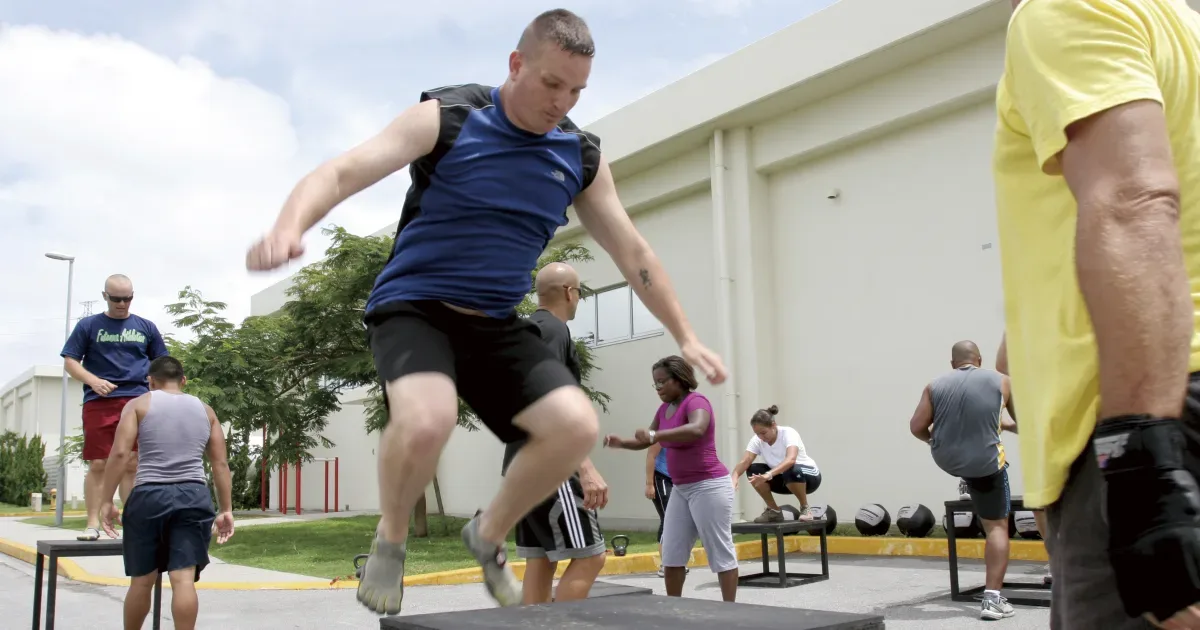
Do jumps improve running economy? What trials and reviews show, how many foot contacts per session, how to progress and where to fit them in your running week.
HRV on your running watch: how to use it in training

What watch HRV is, whether the wrist sensor is reliable and when to swap a hard session for an easy one, with what the research shows and a decision table.
Polarized 80/20 vs pyramidal training: what the studies show
Is 80/20 about time or sessions? What the studies show on polarized, pyramidal and threshold training, and how to measure whether your week is polarized.