
Plyometrics for runners: jumps and running economy
Do jumps improve running economy? What trials and reviews show, how many foot contacts per session, how to progress and where to fit them in your running week.
By Abner SantanaCoach and creator of Magic Training
18 min read
In this article
- What is running economy and why does it decide races?
- What determines running economy?
- What do studies show about jumps and running economy?
- Jumps plus strength training or added load: what the studies combine
- Sample progression based on the study protocols
- Where do jumps fit in your running week?
- Risks: Achilles, calf and foot
- Plyometrics, cadence and technique
- Frequently asked questions
- References
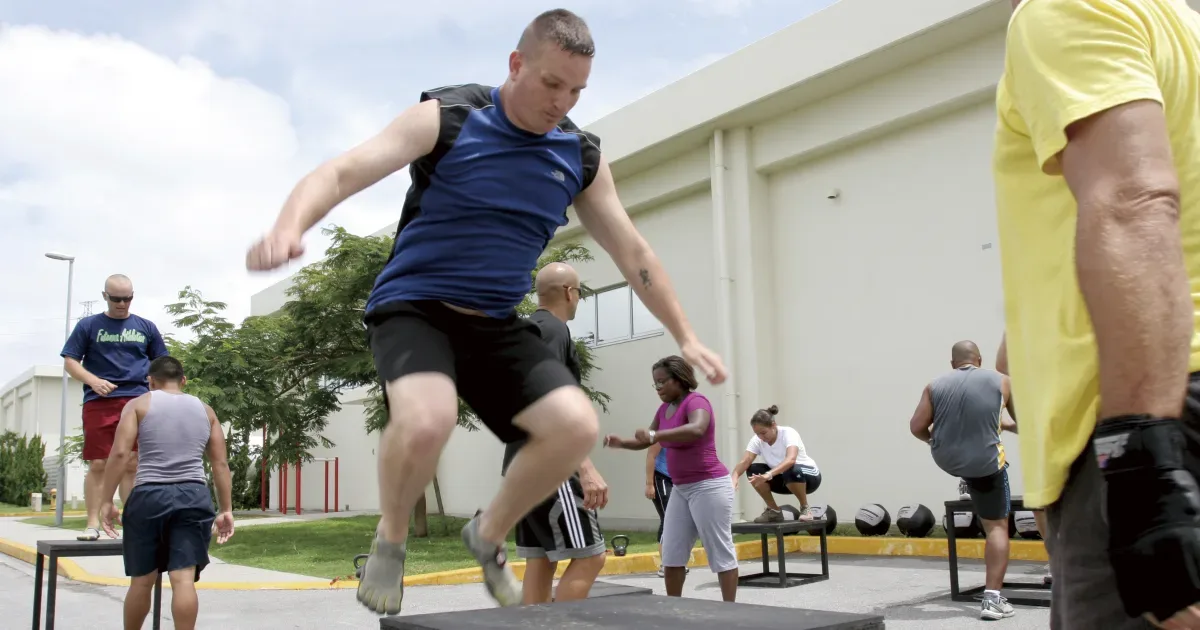
Short, fast jumps (plyometrics) can improve running economy, but the gain is more modest and less consistent than the first trials suggested. In 6 to 9 week trials with trained runners, economy came out about 2% to 6.7% better, depending on the speed tested. Meta-analyses range from a trivial to a moderate effect for jumps alone, and show a larger effect when jumps come with strength training or added load. Running economy is the oxygen you spend to hold a given speed: the less you spend, the more room you have at the same pace.
Below: what the trials and reviews say, the doses the studies used, where jumps fit in your week and who should wait.
Key takeaways
- Running economy is the oxygen cost at a fixed submaximal speed. Among trained runners with similar VO2max, it can vary by up to 30% (Barnes and Kilding, 2015, Sports Medicine - Open).
- Trials of 6 to 9 weeks, with 2 to 3 sessions per week, reported economy 2% to 6.7% better. In Saunders' trial, with very well-trained runners, the 4.1% gain appeared only at 18 km/h, not at 14 or 16 km/h.
- Meta-analyses disagree: jumps alone have a trivial effect in two, a small effect in another and a small to moderate effect in a fourth. Combined with strength training or added load, the effect rises.
- The subgroups with the larger effect used more than 7 weeks, more than 15 sessions and more than 2 days per week. Protocols started with 1 to 2 sets and progressed.
- Ramírez-Campillo's protocol left at least 48 hours between jump sessions. Blagrove's review recommends at least 24 hours before hard running.
- Jumps load the Achilles tendon, calf and foot. Stop at any pain there, and during the taper (a training decision, not a study finding). If you have an injury history, talk to a doctor or physiotherapist first.
What is running economy and why does it decide races?
Running economy is the energy demand at a fixed submaximal speed, usually expressed as oxygen consumption (VO2) at that speed (Barnes and Kilding, 2015). A runner with good economy uses less oxygen than one with poor economy at the same speed in steady state. The review on measurement and determining factors reports that it can vary by up to 30% among trained runners with similar VO2max. It also describes economy as a useful predictor of performance, especially among athletes with similar VO2max (Barnes and Kilding, 2015, Sports Medicine - Open).
That is why VO2max alone does not decide: two runners with the same value can have different oxygen costs at the same pace. Jack Daniels already described in 1985 that the relationship between VO2 and speed differs between people and within the same person. He listed environment (temperature, altitude, surface), fatigue, age, weight and fitness among the factors that affect it. He left two questions open: what kind of training changes economy, and by how much (Daniels, 1985).
In Daniels' method, R pace exists to train speed and economy, as the article on Jack Daniels' training paces explains. If you prefer to see the concept on video, Abner Santana's channel has Running economy: concept and why it matters (video in Portuguese).
What determines running economy?
Economy is a set of metabolic, cardiorespiratory, biomechanical and neuromuscular factors, and the combination is specific to each runner (Barnes and Kilding, 2015, Sports Medicine - Open). Three of them come up often in the review.
- Elastic energy in the tendon. Part of the kinetic and potential energy the body loses in the first half of ground contact is stored as elastic energy and returned in the second half. The review calls it widely accepted that this reuse substantially reduces energy demand.
- Leg and tendon stiffness. In a group of 28 distance runners split by economy, the more economical ones had a stiffer tendon. Stiffness changes with neuromuscular adaptation to training.
- Mass far from the trunk. Every 100 g on the foot raises aerobic demand by about 1%, against about 0.1% on the trunk, according to studies cited by the review.
These are association data between runners, not proof that changing one factor improves economy for everyone. The authors themselves write that the same adjustment can help one athlete and hurt another, because of their other characteristics.
For the tendon, there is an indication in favor of jumps. A 2022 meta-analysis pooled healthy adults, not runners. It concluded that plyometric training increases tendon stiffness (standardized mean difference 0.55; 95% CI 0.28 to 0.82) (Ramírez-delaCruz and colleagues, 2022). Hence the jump hypothesis: short, fast ground contacts would train stiffness and elastic return. Spurrs and colleagues postulated this to explain the economy improvement they saw. It is a hypothesis, and the sections below show that the data with runners do not fully confirm it. The stiffness result appears in the last section, on cadence.
What do studies show about jumps and running economy?
Small trials show economy gains that the reviews, when they pool everything, shrink or split by speed and by type of runner. It helps to look at the trials first and then the syntheses.
Trials with jumps as the main intervention
The table shows what each trial did and found. The Spurrs and Turner numbers by speed, and the dose per session, come from the table in the review by Blagrove and colleagues (2018).
| Study | Runners | Duration and dose | Result |
|---|---|---|---|
| Saunders and colleagues, 2006 | 15 very well-trained (VO2max 71.1 ml/kg/min); 7 with jumps, 8 controls | 9 weeks, 3 sessions of 30 min per week | economy 4.1% better at 18 km/h (p = 0.02); no difference at 14 and 16 km/h; VO2max unchanged |
| Spurrs and colleagues, 2003 | 17 experienced men (60 to 80 km per week) | 6 weeks, 2 to 3 sessions, 60 to 180 contacts | economy better at all speeds tested (6.7% at 12 km/h, 6.4% at 14 and 4.1% at 16); 3 km time 2.7% shorter |
| Turner and colleagues, 2003 | 18 regular runners, not highly trained | 6 weeks, 3 sessions, 40 to 110 contacts | economy better (p < 0.05), 2% to 3% on average across speeds; no change at 9.6 km/h |
| Ramírez-Campillo and colleagues, 2014 | 36 competitive middle- and long-distance runners | 6 weeks, 2 sessions of 60 drop jumps | 2.4 km time 3.9% shorter; the abstract does not report economy |
Three caveats. Spurrs recorded a 2.7% shorter 3 km time in the jump group, but Blagrove's review marks that difference as not significant relative to the control. Saunders' protocol also included resistance exercises (leg press at 60% of 1RM, among others), according to the same review. And in Turner the jump tests did not show a greater ability to store and return elastic energy, so the authors leave the mechanism open.
What the reviews add up
The values below are effect sizes (g, ES or standardized mean difference), not percentages, with the sign as each study published it. The labels (trivial, small, moderate, large) are those of each paper, with thresholds that may differ between them, so compare the numbers with caution. In Balsalobre-Fernández, Eihara and Llanos-Lagos, negative values favor the intervention. In Ramírez-Campillo and Dudagoitia Barrio, positive values favor it.
| Review | What was included | Running economy | Performance |
|---|---|---|---|
| Balsalobre-Fernández and colleagues, 2016 | 5 trials, 93 high-level runners (VO2max above 60); strength plus jumps, 8 to 12 weeks | -1.42 (95% CI -2.23 to -0.60), large effect | not analyzed |
| Blagrove and colleagues, 2018 | 24 strength studies (resistance, explosive and plyometric), runners with 6 months or more of practice | in 20 studies, generally a 2% to 8% improvement over control, but not always | 1.5 to 10 km time trial tended to improve |
| Ramírez-Campillo and colleagues, 2021 | 21 studies, 511 endurance runners, jumps only | small to moderate improvement (ES 0.36 to 0.73, a range that also covers jump, sprint and reactive strength) | 2 to 5 km: ES 0.88, moderate |
| Eihara and colleagues, 2022 | 22 studies, long-distance runners | jumps g = -0.13 (95% CI -0.47 to 0.21), trivial; heavy load g = -0.32 | jumps g = -0.17 (95% CI -0.27 to -0.06), classified as trivial, but with an interval that does not include zero |
| Dudagoitia Barrio and colleagues, 2023 | 18 studies (10 in the meta-analysis), jumps in endurance runners | jumps alone ES 0.19, trivial; jumps with added load ES 1.34 | not analyzed |
| Llanos-Lagos and colleagues, 2024 (economy) | studies of 6 to 24 weeks, 1 to 4 sessions per week | jumps up to 12 km/h: ES -0.307, small; combined methods: ES -0.426, moderate | not analyzed |
| Llanos-Lagos and colleagues, 2024 (performance) | studies of 6 to 40 weeks | not analyzed | jumps ES -0.210 (p = 0.064), not significant; combined methods ES -1.035, large |
How to read the disagreement
The results do not line up, and there are concrete reasons. The trials are small (7 runners against 8, in Saunders), and the syntheses mix training levels and speeds. In Eihara's review, the average duration of jump studies was 6.9 weeks, against 9.6 for heavy-load ones. The effect of jumps was small at 8 to 10 weeks and trivial at 4 to 6. The authors also point out that in highly trained runners, economy is already well developed and hard to improve further.
Speed also shows up as a moderator, and in different directions. Saunders found a gain only at 18 km/h, while Llanos-Lagos and colleagues found an effect of jumps at speeds up to 12 km/h. Dudagoitia Barrio and colleagues had better results in more trained runners and at higher speeds in the subgroup analysis. In other words, nobody can say at which pace the gain will show up.
Jumps plus strength training or added load: what the studies combine
The best numbers appear when jumps accompany strength training or added load, not when they come alone. The typical protocol in the 2016 meta-analysis combined 2 to 4 resistance exercises for the legs, up to 200 jumps and 5 to 10 short sprints. It was done 2 to 3 times per week, for 8 to 12 weeks. The authors concluded that this format is an adequate strategy for highly trained runners (Balsalobre-Fernández and colleagues, 2016).
In the 2023 synthesis, jumps with added load had an ES of 1.34, against 0.19 for jumps alone. In the 2022 one, heavy load (g = -0.32) had a larger estimate than plyometrics (g = -0.13) for economy, and the authors suggest a particular advantage for loads near the maximum. Read jumps, then, as a complement to that base, not a substitute.
Sample progression based on the study protocols
The table is a sample progression based on the study protocols, not a prescription. The order of the stages is this article's own organization. The exercises, doses and heights come from the protocols cited, and the last column says where.
The review by Blagrove and colleagues (2018) summarizes the dose: 1 to 6 exercises in 1 to 6 sets of 4 to 10 repetitions, from 30 to 228 contacts per session. Ground contacts under 0.2 s mimic running contact times. Exercises with low to moderate eccentric demand, such as drop jumps from a 20 to 30 cm box, skipping, hops and bounding, seem the most suitable. Most studies started with 1 to 2 sets and went up to 3 to 6.
| Exercise | Example | Level | When it enters | Dose (sample range) and source |
|---|---|---|---|---|
| Ankle hops | continuous jumps in place, short ground contact | 1, base | weeks 1 and 2 | 1 to 2 sets; Saunders listed ankle jumps; 30 to 60 contacts per session |
| Skipping | skipping with height and rhythm | 1, base | weeks 1 and 2 | Saunders and Blagrove; same range of contacts |
| Countermovement jump | quick squat and vertical jump, with controlled landing | 2 | weeks 3 and 4 | Saunders; 60 to 100 contacts per session |
| Low hurdle jump | short sets of continuous jumps over low hurdles | 2 | weeks 3 and 4 | Saunders, according to Blagrove; 60 to 100 contacts |
| Bounding | 10 to 30 m of long strides, alternating legs | 3 | weeks 5 and 6 | Saunders (10 to 30 m) and Spurrs; 100 to 150 contacts |
| Single-leg hops | jumps on one leg, in place or forward | 3 | weeks 5 and 6 | Spurrs progressed from two legs to one leg and to more height |
| Drop jumps | step off a 20 to 30 cm box and jump immediately | 3 to 4 | from week 7 | Blagrove points to 20 to 30 cm; Ramírez-Campillo used 20, 40 and 60 cm, in 6 sets of 10, with competitive runners |
| Uphill jumps | short, continuous jumps on a ramp | 4 | from week 7 | Turner, 40 to 110 contacts per session |
A counting example for the first week: 2 sets of 15 ankle hops and 2 sets of 15 skips (counting each stride) add up to 60 contacts, the top of the starting range. In the third week, 3 sets of 10 countermovement jumps and 3 of 10 over a low hurdle also add up to 60 contacts, the start of the next range. The contact ranges for each stage take as limits the floor of 30 from Blagrove's review, the 60 of Ramírez-Campillo, the 40 to 110 of Turner and the 60 to 180 of Spurrs. The ceiling that appeared in the protocols was 228 per session, and the 2016 meta-analysis cites up to 200 jumps. Ramírez-Campillo used two sessions per week, Spurrs two to three, Turner and Saunders three.
Blagrove's review does not describe the surface used in the protocols. A review of Achilles tendon risk factors suggests, for people recovering from an injury there, avoiding soft surfaces (Lorimer and Hume, 2014).
Where do jumps fit in your running week?
In most studies reviewed by Blagrove and colleagues, strength and running were on separate days or sessions. Only three studies did one right after the other, and in one of them (Ramírez-Campillo) the jumps came before the run, with at least 48 hours between jump sessions. The authors recommend at least 24 hours between a strength session and a hard run. If strength falls on the same day as a hard running workout, they recommend more than 3 hours after it. In one study, those who did strength right after an incremental run had no additional benefit, and the cause given was residual fatigue.
The table is an example built with those windows, for a runner with one interval session and one long run per week. It is not a prescription.
| Day | Run | Jumps |
|---|---|---|
| Monday | rest | no |
| Tuesday | easy run | session 1, before the run |
| Wednesday | intervals | no |
| Thursday | easy run | no |
| Friday | short easy run | session 2, before the run |
| Saturday | rest or easy run | no |
| Sunday | long run | no |
The jumps sit 48 hours after the long run, 48 hours before it and 24 hours before the interval session, the minimum of the recommendation. A single session per week also worked in one of the reviewed studies, which lasted 8 weeks and used drop jumps.
Which phase of the plan?
None of the studies cited here compares phases of a plan. They add jumps to normal training for 6 to 9 weeks, and the subgroups with the larger effect had more than 7 weeks and more than 15 sessions (Dudagoitia Barrio and colleagues, 2023). Two sessions per week for 8 weeks make 16 sessions. The example on this page uses two sessions, below that subgroup's criterion of more than 2 days per week. A third session would require giving up the 48-hour gap from the long run that this example adopts, or designing the week differently. Thinking of a block of 8 to 10 weeks early or in the middle of the plan, and not in the peak weeks, is a training decision derived from this, not a finding.
A separate 40-week study did 2 weekly strength sessions for 20 weeks and then one per week. The one-session phase added a small improvement (ES 0.3) over the previous phase (ES 1.0), according to Blagrove and colleagues (2018). The session was mixed, with load and jumps, so the lesson for jumps alone is limited.
When to drop them
Two cases call for a pause. In the taper, no study has tested plyometrics, and the decision is a training one, with no research behind it. Because the recovery windows above require a gap before hard running, the jump session is the natural candidate to go. The article on the marathon taper details that phase. With pain in the Achilles, calf or sole of the foot, the jump session stops, and the issue goes to a doctor or physiotherapist. More on symptoms and return in running injuries.
Risks: Achilles, calf and foot
Jumps load the Achilles tendon and the calf, which store and return energy with every stride. The abstracts of the reviews cited here measure economy and performance, not injury, so there is no injury rate per jump in runners to present. The caution comes from the authors' guidance. For people with no prior strength training, Blagrove and colleagues (2018) write that gradual prescription and progression are important to avoid injury and overtraining. They also say that an initial period of heavy load tends to give a long-term advantage in reducing injury risk.
Who should wait or talk to a doctor or physiotherapist first:
- current or recent pain in the Achilles, calf, sole of the foot, shin or knee;
- a history of stress injury or tendinopathy, or an injury return under way;
- no experience with strength training: in that case, the strength base comes first (see strengthening training and exercises for runners).
This page is not medical advice, and the decision about your case belongs to a professional who examines you.
Plyometrics, cadence and technique
Jumps are not a shortcut to a specific cadence. The meta-analysis of jumps in endurance runners saw improvement in 2 to 5 km race time, economy, jumping and sprinting. It saw no change in stiffness or in step frequency at submaximal speeds (Ramírez-Campillo and colleagues, 2021).
That result matches what Barnes and Kilding report about stride. Oxygen consumption was lower at stride lengths close to the one the runner chose. Cavanagh and Williams concluded there is little need to dictate stride length, because most runners already use nearly optimal values (Barnes and Kilding, 2015, Sports Medicine - Open).
The cadence page treats the 170 to 180 steps per minute observed in elites as a reference, not an absolute rule, and that is how the number should be read. To see technique as a whole, Abner Santana's channel has Efficient running biomechanics: maximizing economy through technique (video in Portuguese). For speed beyond economy, see how to run faster.
Frequently asked questions
Does plyometric training really improve running economy?
In small trials of 6 to 9 weeks, yes, by 2% to 6.7%, but the meta-analyses disagree. Two found a trivial effect for jumps (one with g = -0.13 and an interval that includes zero), another found a small effect at speeds up to 12 km/h, and a fourth a small to moderate one. Combined with strength training or added load, the evidence is more favorable.
How many jumps per session?
The protocols used 30 to 228 contacts per session: 40 to 110 in Turner, 60 to 180 in Spurrs, 60 in Ramírez-Campillo. Most started with 1 to 2 sets and went up to 3 to 6 over the weeks. A sample session starts at the low end of the range and rises gradually, as in the progression table above.
How many times per week and for how many weeks?
Two or three sessions per week was the standard in the studies Blagrove reviewed. The larger-effect subgroups in Dudagoitia Barrio and colleagues had more than 7 weeks, more than 15 sessions and more than 2 days per week. Eihara saw a small effect at 8 to 10 weeks and a trivial one at 4 to 6. That is a comparison between subgroups, not a proven minimum dose.
Can I do jumps on the same day as a run?
The studies varied. Most separated strength and running, and Ramírez-Campillo did the jumps before the run. Blagrove and colleagues recommend more than 3 hours after a hard running workout and at least 24 hours between the strength session and the next hard run. On interval or long-run days, the jump session is left out.
Do jumps increase cadence?
There is no basis to expect that. The meta-analysis of jumps in endurance runners found no change in step frequency at submaximal speeds. Barnes and Kilding's review indicates that runners tend to choose a stride close to their most economical one, so a fixed cadence number should not be treated as a target.
References
- Barnes KR, Kilding AE. Strategies to improve running economy. Sports Medicine, 2015;45(1):37-56. PubMed 25164465
- Barnes KR, Kilding AE. Running economy: measurement, norms, and determining factors. Sports Medicine - Open, 2015;1(1):8. PMC4555089
- Daniels JT. A physiologist's view of running economy. Medicine and Science in Sports and Exercise, 1985;17(3):332-8. PubMed 3894870
- Saunders PU, Telford RD, Pyne DB, Peltola EM, Cunningham RB, Gore CJ, Hawley JA. Short-term plyometric training improves running economy in highly trained middle and long distance runners. Journal of Strength and Conditioning Research, 2006;20(4):947-54. PubMed 17149987
- Spurrs RW, Murphy AJ, Watsford ML. The effect of plyometric training on distance running performance. European Journal of Applied Physiology, 2003;89(1):1-7. PubMed 12627298
- Turner AM, Owings M, Schwane JA. Improvement in running economy after 6 weeks of plyometric training. Journal of Strength and Conditioning Research, 2003;17(1):60-7. PubMed 12580657
- Ramírez-Campillo R, Alvarez C, Henríquez-Olguín C, Baez EB, Martínez C, Andrade DC, Izquierdo M. Effects of plyometric training on endurance and explosive strength performance in competitive middle- and long-distance runners. Journal of Strength and Conditioning Research, 2014;28(1):97-104. PubMed 23838975
- Balsalobre-Fernández C, Santos-Concejero J, Grivas GV. Effects of strength training on running economy in highly trained runners: a systematic review with meta-analysis of controlled trials. Journal of Strength and Conditioning Research, 2016;30(8):2361-8. PubMed 26694507
- Blagrove RC, Howatson G, Hayes PR. Effects of strength training on the physiological determinants of middle- and long-distance running performance: a systematic review. Sports Medicine, 2018;48(5):1117-49. PubMed 29249083, PMC5889786
- Ramírez-Campillo R, Andrade DC, García-Pinillos F, Negra Y, Boullosa D, Moran J. Effects of jump training on physical fitness and athletic performance in endurance runners: a meta-analysis. Journal of Sports Sciences, 2021;39(18):2030-50. PubMed 33956587
- Eihara Y, Takao K, Sugiyama T, Maeo S, Terada M, Kanehisa H, Isaka T. Heavy resistance training versus plyometric training for improving running economy and running time trial performance: a systematic review and meta-analysis. Sports Medicine - Open, 2022;8(1):138. PubMed 36370207, PMC9653533
- Ramírez-delaCruz M, Bravo-Sánchez A, Esteban-García P, Jiménez F, Abián-Vicén J. Effects of plyometric training on lower body muscle architecture, tendon structure, stiffness and physical performance: a systematic review and meta-analysis. Sports Medicine - Open, 2022;8(1):40. PubMed 35312884
- Dudagoitia Barrio E, Fernández-Landa J, Negra Y, Ramirez-Campillo R, García de Alcaraz A. Effects of plyometric jump training on running economy in endurance runners: a systematic review and meta-analysis. Kinesiology, 2023;55(2):270-81. DOI 10.26582/k.55.2.11. Full text
- Llanos-Lagos C, Ramirez-Campillo R, Moran J, Sáez de Villarreal E. Effect of strength training programs in middle- and long-distance runners' economy at different running speeds: a systematic review with meta-analysis. Sports Medicine, 2024;54(4):895-932. PubMed 38165636, PMC11052887
- Llanos-Lagos C, Ramirez-Campillo R, Moran J, Sáez de Villarreal E. The effect of strength training methods on middle-distance and long-distance runners' athletic performance: a systematic review with meta-analysis. Sports Medicine, 2024;54(7):1801-33. PubMed 38627351, PMC11258194
- Lorimer AV, Hume PA. Achilles tendon injury risk factors associated with running. Sports Medicine, 2014;44(10):1459-72. PubMed 24898814
Find your plan
Which plan fits your next race?
Answer a few questions about distance, goal and routine and see the plans that fit where you are right now.
Find my planKeep reading
Strength training for runners: 2 to 3 sessions a week
What the reviews show about strength and running, how many sessions a week, what load and which exercises to use, and how to adjust from base to taper.
HRV on your running watch: how to use it in training

What watch HRV is, whether the wrist sensor is reliable and when to swap a hard session for an easy one, with what the research shows and a decision table.
Polarized 80/20 vs pyramidal training: what the studies show
Is 80/20 about time or sessions? What the studies show on polarized, pyramidal and threshold training, and how to measure whether your week is polarized.